Ammonia Cracking
Solving the 'last mile' challenge in hydrogen delivery.
- Electricity Consumption: 0.9 KWh/Nm³ H₂
- Operating Ratio: 0 - 120%
- Ratio Adjustment Rate: 1%/min
- Start-up Time: 2.5~3 h
- Hydrogen Purity: ~7 N
- Residual Ammonia: < 0.01 ppm
Get a Quote
Technology
-

High Purity
99.999% high-purity
hydrogen, applicable for
chip manufacturing.
-

Metal Membrane
High strength
Easy to scale up
High hydrogen permeability
Resistant to high pressure &
pressure shock
-

Catalyst
NiO based catalyst
Operating in 750-800 °C
Chemical composition: NiO, Al2O3, etc.
-

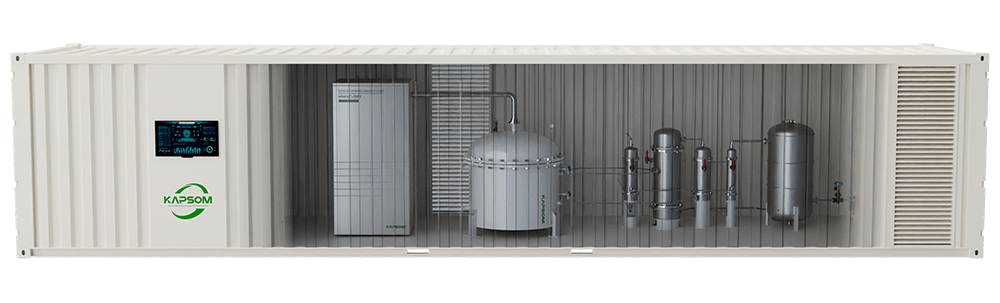
Compact Design
Designed to fit inside a
standard 40HQ container,
facilitating convenient
shipping and on-site assembly.
Featured Projects
-
Pure Hydrogen Powering a Fuel CellIn 2026, KAPSOM successfully completed an ammonia cracking pilot test in the laboratory. The resulting 99.999% pure hydrogen successfully powered a fan via a hydrogen fuel cell, achieving a controllable ammonia cracking experiment.Read More
-
100 Nm³/h & 150 Nm³/h Ammonia Cracking PlantsDetailed overview of the 100 Nm³/h and 150 Nm³/h ammonia cracking systems. We can also custom-build units with different production capacities tailored to your requirements.Read More
Leave A Message
Service Tailored to Your Needs
-
Preliminary planning and performance assurance
Assess asset lifecycle value based on business cases
Provide reliability and feasibility analysis to ensure control during the design phase
-
Digital spare parts management
Efficient spare parts supply and delivery
Support material requirements during the construction and operation phases
-
Remote monitoring and O&M support
Online monitoring and remote troubleshooting
Assist on-site engineers to ensure smooth commissioning
-
Customer service support
Full-process issue and request handling
Provide basic service support
Reasons to Choose Us
-
 Enhanced ScalabilityAllows for gradual expansion of production capacity, adapting easily to increasing demand or budget constraints.
 -
 Cost EfficiencyStandardized modules often result in reduced manufacturing and installation costs, offering economic advantages over traditional plant setups.
 -
 Faster DeploymentPrefabricated units enable quicker assembly and commissioning, significantly shortening project timelines from design to operation.
 -
 Location FlexibilityTheir compact and self-contained nature makes them suitable for diverse locations, including remote or constrained sites.
 -
 Lower Environmental FootprintModular designs can be more environmentally friendly, requiring less land and potentially having lower emissions.
 -
 Simplified Maintenance and UpgradesThe modular approach facilitates easier maintenance and potential upgrades of individual components without major disruptions.
 -
 Improved Energy EfficiencyThese designs can be optimized for better energy use, crucial for processes reliant on renewable energy sources.
 -
 Customizable SolutionsOffers the flexibility to tailor modules to specific project needs or operational requirements.

 IPv6 network supported