
KAPSOM Advances Ammonia Adsorption Composites
KAPSOM recently completed a laboratory demonstration of its ammonia adsorption composite material, marking another step in the company’s research into lower-pressure ammonia synthesis. The study focuses on adsorption-enhanced ammonia synthesis, a route that may support more compact and energy-efficient green ammonia systems by replacing conventional cooling-based ammonia separation with selective adsorption.
The traditional Haber-Bosch NH3 synthesis process is limited by its low single-pass conversion rate. Even with state-of-the-art catalysts, the circulation loop pressure still needs to be maintained at 8-10 MPa to ensure sufficient ammonia liquefaction. In contrast, adsorption-enhanced ammonia synthesis technology uses adsorption separation instead of cooling separation, potentially reducing circulation pressure from 10 MPa to 1-5 MPa. The prerequisite for industrial application of this route is the availability of stable and efficient adsorbents. Metal halides show great promise for efficient chemisorption of ammonia through complexation; however, when pure salts adsorb ammonia, lattice expansion can lead to macroscopic bed expansion and clogging of the adsorber.
Our laboratory is developing an ammonia adsorption composite material with high stability and high adsorption capacity. In a demonstrative experiment, we observed the dynamic adsorption process of ammonia. As shown here, a quartz tube was filled with adsorbent, and a binary mixture of NH3 and N2 was continuously passed through it. Due to the formation of complexes during adsorption, the evolution of the adsorption front could be clearly observed: no NH3 signal was detected by gas chromatography before the top region turned blue, which fully demonstrates its excellent kinetic adsorption performance. Furthermore, the breakthrough time and mechanical strength of the particles remained consistent throughout the three-cycle experiment.
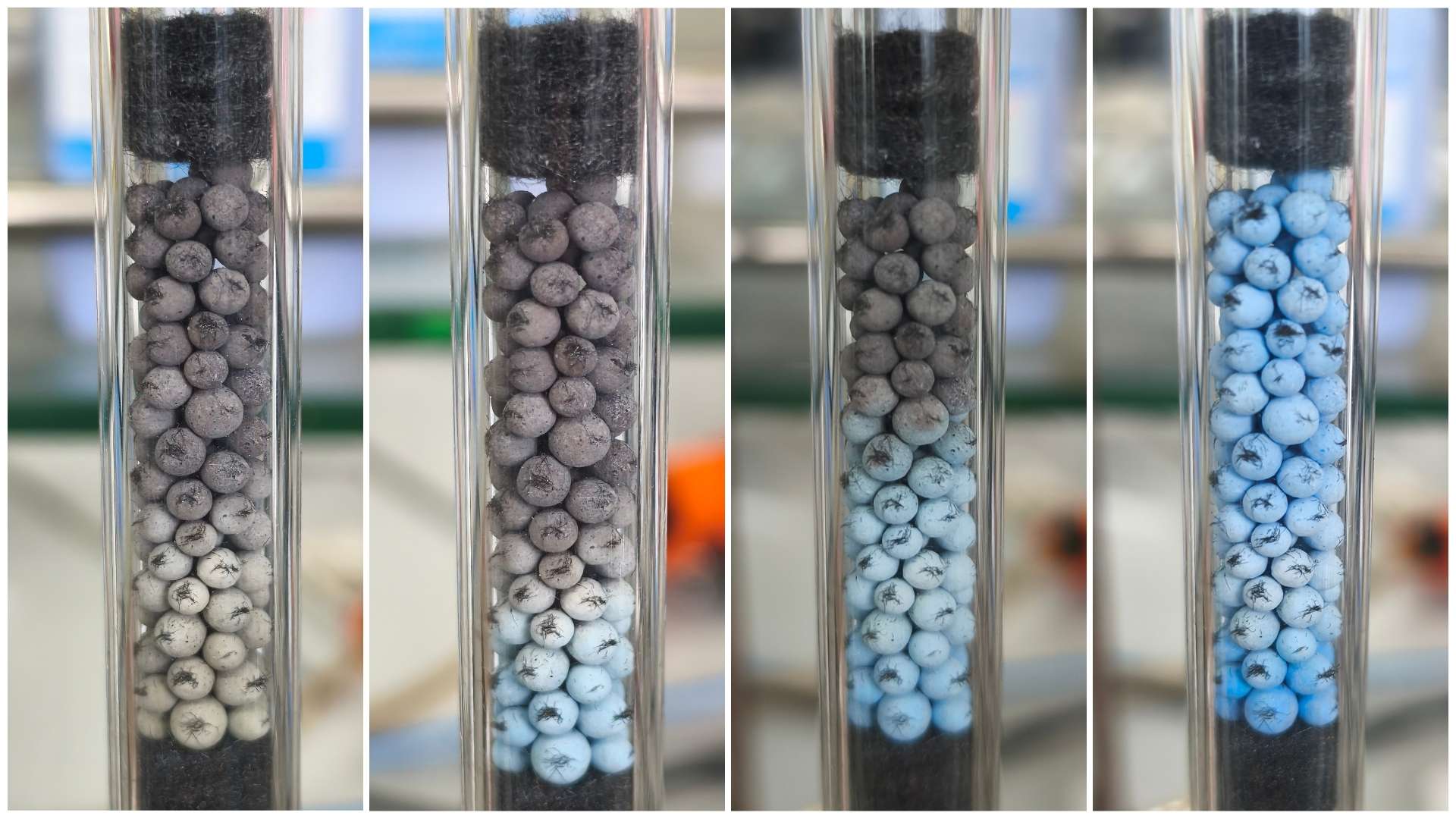 The Adsorption Process of Adsorbent
The results provide an encouraging basis for further development of adsorption-enhanced ammonia synthesis. KAPSOM will continue to optimize the material formulation, adsorption capacity, particle strength, and cyclic stability, while evaluating its compatibility with practical ammonia synthesis conditions. This work supports the company’s broader effort to develop more flexible, modular, and energy-efficient green ammonia production technologies.

 IPv6 network supported