Leave A Message


Can Green Ammonia Be Truly Plug-and-Play?
Two Different Pictures of Plug-and-Play
Imagine buying a green ammonia production system that works like a household appliance: connect it to electricity and water, press a button, and start producing ammonia.
For some customers, this is what "plug-and-play" means.
For chemical engineers, however, the term usually describes something different: a compact, modular system with extensive factory prefabrication, designed to reduce on-site construction and installation.
Both perspectives make sense. But the gap between them raises an interesting question: How close can green ammonia production get to true plug-and-play operation?
Why the Gap Exists
In consumer electronics, plug-and-play often means minimal setup. Industrial chemical production is more complicated.
A complete green ammonia plant typically integrates several processes, including water treatment, hydrogen production, nitrogen supply, ammonia synthesis, and product handling or storage.
Modular engineering simplifies this complexity through prefabricated skids, standardized interfaces, and integrated systems.
However, reducing on-site work does not eliminate it. Equipment foundations, piping connections, electrical installation, testing, commissioning, and safety approvals may still be necessary.
In other words, modular does not necessarily mean self-contained.
Why Modular Systems Still Look Like Factories
A modular ammonia plant may be smaller and easier to install than a conventionally constructed facility, but its final appearance often remains industrial.
One reason is process integration. Different production units must be connected through piping, electrical systems, and control networks. Depending on the layout, these connections may require pipe racks or other supporting structures.
Another important consideration is safety.
Hydrogen is highly flammable, while ammonia presents significant toxicity hazards. Equipment arrangement must account for ventilation, maintenance access, emergency response, hazardous material inventories, and appropriate separation distances.
The World Bank Group's EHS Guidelines for Nitrogenous Fertilizers recommend separating process, storage, utility, and safe areas, with safety distances informed by site-specific assessments.
Requirements also differ across jurisdictions. The OECD's study on hydrogen safety regulation highlights how equipment configuration, hydrogen inventory, and risk assessment influence safety requirements.
Therefore, a compact design cannot be judged by its footprint alone.
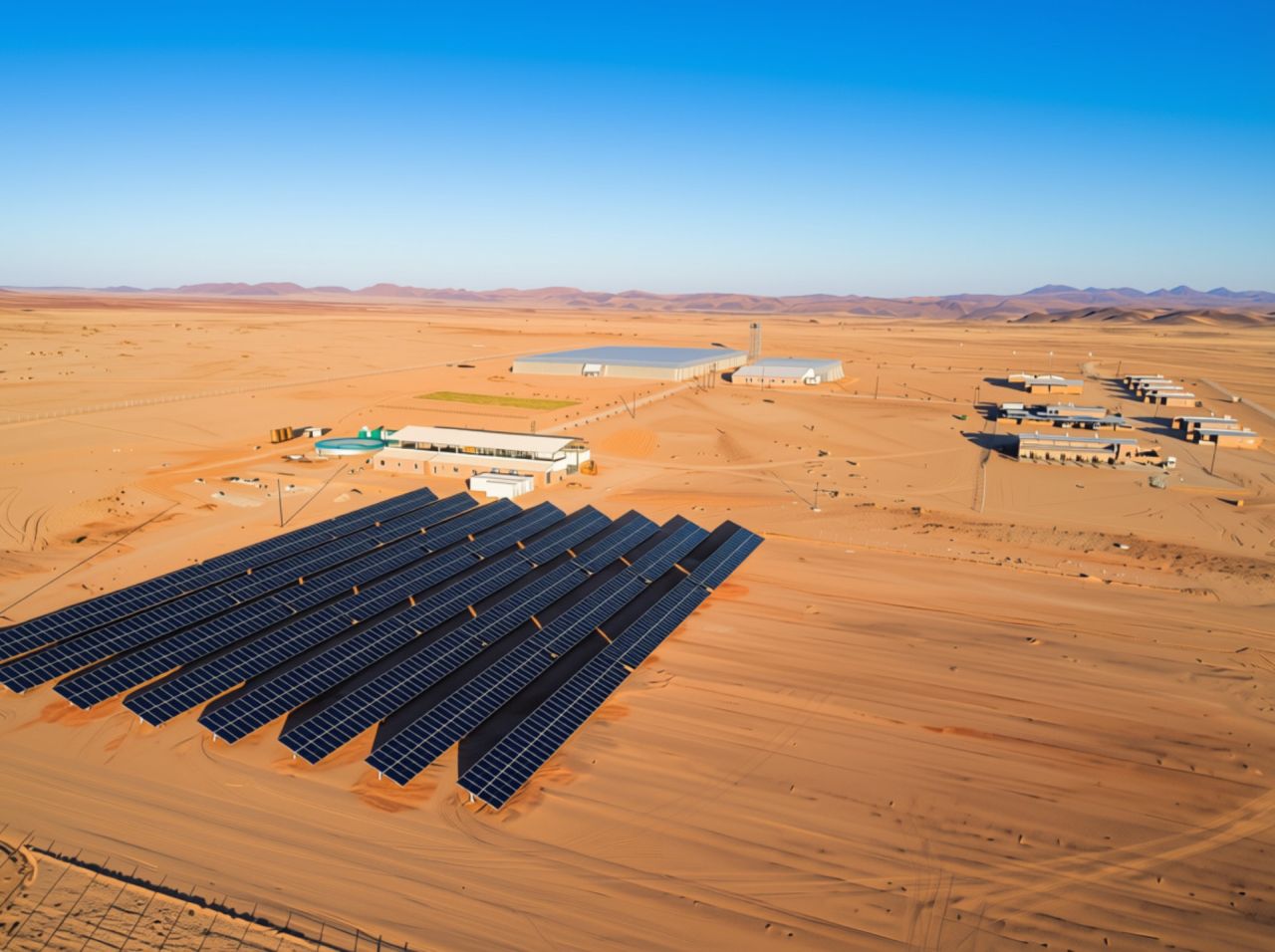
KAPSOM's 100 TPA Green Ammonia Factory in Namibia
Could an Ammonia Plant Become an Appliance?
Some emerging distributed ammonia production concepts already feature highly integrated equipment with remarkably compact layouts. Visually, they may resemble industrial machines more than conventional chemical plants.
Such designs suggest interesting possibilities, particularly at smaller production capacities.
However, appearance does not reveal the complete engineering picture. Utilities, storage, safety systems, site conditions, and local permitting requirements still need to be considered.
A compact system may be suitable for one application or jurisdiction without being directly transferable to another.
The question is not simply whether equipment can be made smaller, but whether the complete production system can be safely integrated and deployed with less on-site complexity.
The Next Generation of Plug-and-Play
Future developments may bring green ammonia production closer to customers' expectations.
Greater system integration, standardized connections, lower hazardous material inventories, automated controls, and remote monitoring could all help simplify deployment and operation.
Advances in process technology may also create opportunities for more compact configurations, provided that applicable safety requirements are satisfied.
Perhaps true plug-and-play green ammonia will not mean eliminating every installation step. Instead, it may mean making those steps increasingly standardized, predictable, and straightforward.
The ultimate goal is not merely to build a smaller factory, but to make ammonia production easier to deploy without compromising safety.





Leave A Message
Scan to Wechat :

 IPv6 network supported