Leave A Message


Can Product Removal Improve Ammonia Synthesis?
Removing ammonia as it forms can increase ammonia synthesis conversion by shifting the reaction equilibrium toward further product formation. In principle, this could reduce recycle requirements, lower separation energy and support more compact ammonia plants.
The difficulty lies in how ammonia is removed. Membranes, adsorbents and absorbents can all provide additional driving force for the reaction, but each introduces its own material, energy and equipment requirements. The most effective commercial solution may therefore be separation-enhanced ammonia synthesis without placing the catalyst and separation material inside the same reactor.
Why Ammonia Synthesis Is Limited by Equilibrium
Ammonia synthesis follows the reversible reaction: N₂ + 3H₂ ⇌ 2NH₃
High pressure favors ammonia formation. Lower temperature is also thermodynamically favorable, but it reduces the reaction rate. Industrial ammonia synthesis therefore requires a compromise between pressure, temperature, catalyst activity and ammonia separation.
Because only part of the hydrogen and nitrogen is converted in a single pass, conventional systems cool the reactor outlet to condense ammonia and recycle the unreacted gases. This recycle loop requires compressors, heat exchangers, separators and associated auxiliary energy.
If ammonia could be removed during or immediately after formation, its partial pressure in the reaction gas would decrease. According to Le Chatelier’s principle, this would allow additional hydrogen and nitrogen to react, potentially increasing single-pass conversion.
What an Ammonia-Selective Membrane Could Achieve
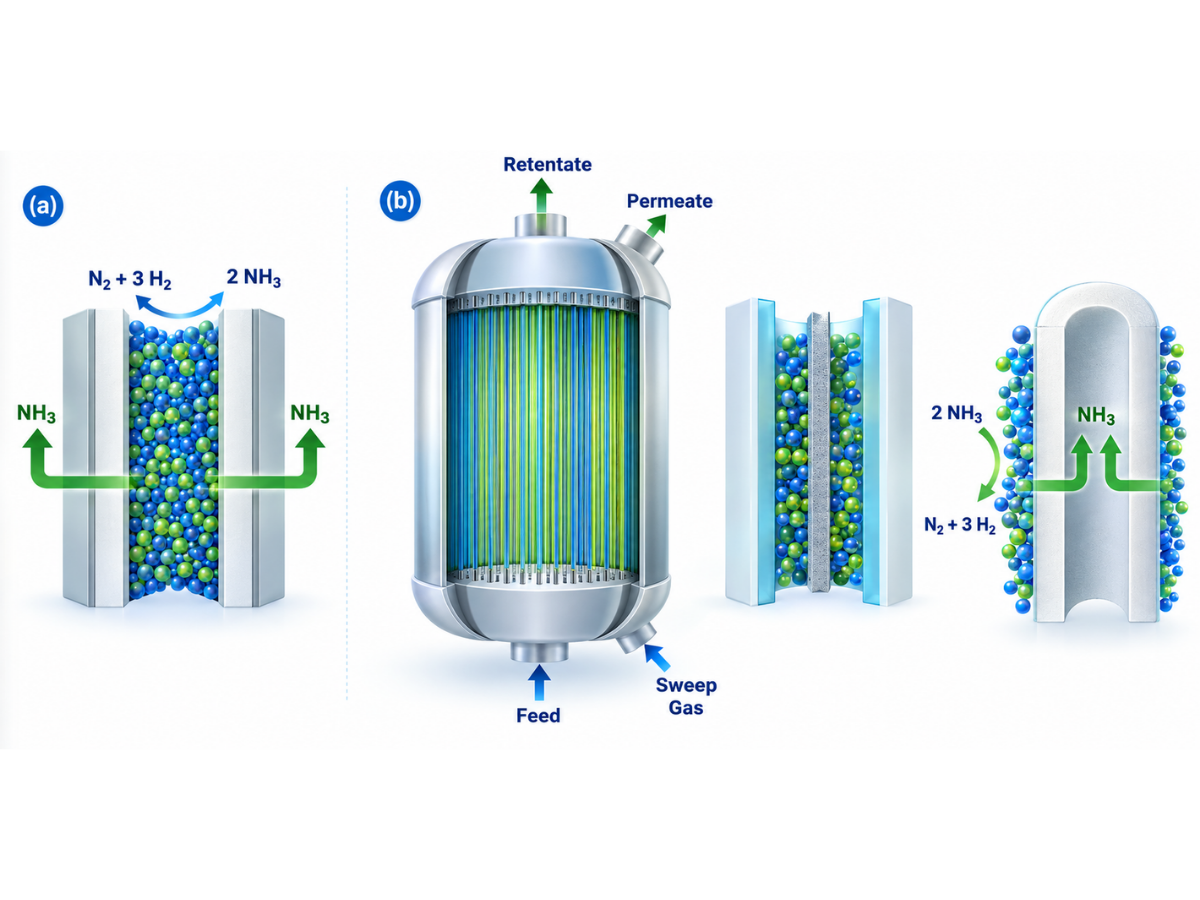
An ammonia-selective membrane reactor would continuously transport ammonia away from the reaction zone while retaining most of the hydrogen and nitrogen. The unreacted gases could then remain on the high-pressure side and return to the reaction section.
A published modeling study found that the benefits became significant when ammonia permeance exceeded approximately 100 GPU. The model also indicated that the membrane required an NH₃/H₂ and NH₃/N₂ selectivity of at least 10 to prevent excessive loss of reactant gases.
Under the modeled conditions at 30 bar, a high-performance membrane could potentially recover nearly all the ammonia produced. The remaining high-pressure hydrogen and nitrogen could then be recycled with little or no recompression.
The same study suggested that effective ammonia removal might allow operation at approximately 300 °C while achieving conversion above that of a conventional reactor operating at 400 °C. Lower-temperature operation could become especially valuable if it is combined with a catalyst that remains sufficiently active under these milder conditions.
These figures are modeling results rather than guaranteed commercial performance. They nevertheless help define the membrane properties required before the concept can become practically meaningful.
High Conversion Can Come with Difficult Conditions
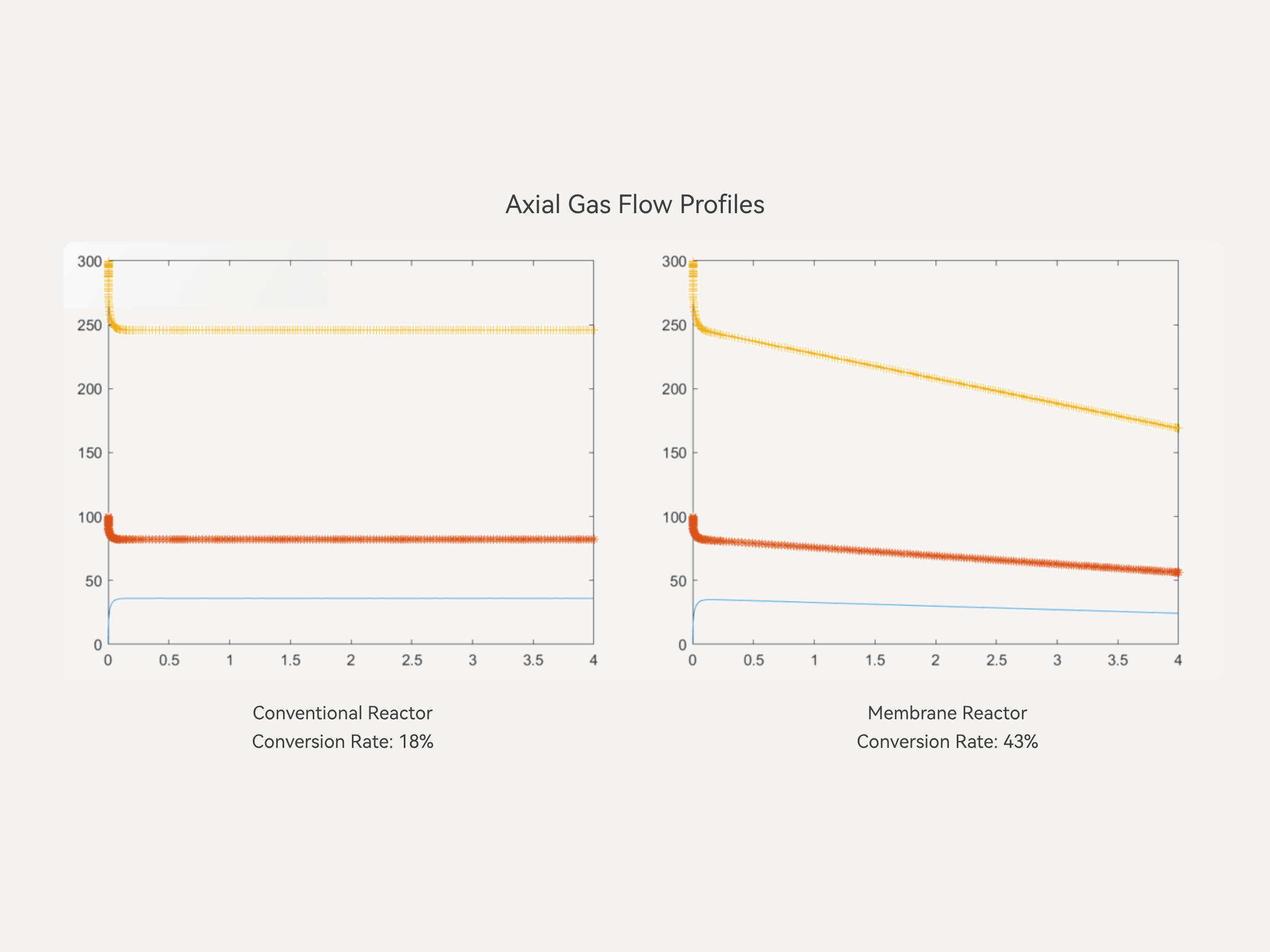
A more recent modeling study examined a membrane reactor combining ammonia synthesis, cooling and ammonia separation. The proposed system used an iron-based catalyst and a zirconia-supported ZnCl₂ immobilized molten-salt membrane.
The model predicted approximately 47% nitrogen conversion at 613 K and 50 bar. This was substantially higher than the corresponding membrane-free case and showed the potential value of continuously removing ammonia.
However, the modeled performance depended on demanding operating conditions. The system required a nitrogen sweep flow approximately 50 times greater than the reactive feed, while the membrane temperature had to remain below 623 K.
A large sweep stream would dilute the ammonia product and create additional downstream separation and circulation requirements. The narrow temperature limit could also complicate heat integration between the synthesis catalyst and the membrane.
The result therefore demonstrates both sides of reaction–separation integration: removing ammonia can deliver much higher conversion, but the equipment needed to maintain the separation driving force may offset part of the benefit.
What Prevents Commercial Deployment?
An ammonia-selective membrane must satisfy several requirements simultaneously:
Many candidate materials—including ionic liquids, molten salts and polymeric carrier systems—perform well in one area but remain limited in others. A membrane with high selectivity may have insufficient permeance, while a membrane with high transport capacity may lack the mechanical or thermal stability required for industrial synthesis conditions.
The permeate side creates another challenge. Ammonia removal requires a sufficiently low ammonia chemical potential outside the membrane. This may require a sweep gas, vacuum, cooling or an additional absorption stage.
Each option introduces an energy or equipment penalty. Sweep gas dilutes the ammonia product, vacuum operation consumes power, and absorption requires additional regeneration and product-recovery steps.
Can Adsorption Offer a More Practical Route?
Membranes are not the only method of removing ammonia. A solid adsorbent can selectively capture ammonia and temporarily reduce its concentration in the reaction gas.
Adsorbent development is generally less demanding than producing large areas of defect-free membrane material. Chemically reactive adsorbents, particularly metal-halide composites, can also provide much higher ammonia uptake than conventional physical adsorbents.
The trade-off is that adsorption is not continuous. Once saturated, the adsorbent must be regenerated by heating, pressure reduction, purging or a combination of these methods.
Adsorption strength must also be carefully controlled. Weak adsorption provides insufficient capacity and equilibrium enhancement, while excessively strong adsorption increases regeneration energy. Repeated ammonia coordination may cause swelling, agglomeration, cracking or pulverization, leading to capacity loss and higher pressure drop.
KAPSOM’s Research Direction
KAPSOM’s current research does not assume that the catalyst and separation material must immediately be combined in one reactor.
Instead, the company is investigating how ammonia-selective adsorption, absorption and membrane separation can be arranged around a conventional synthesis loop. This approach allows the reactor and separation unit to be optimized, maintained and replaced independently.
A separate configuration may still improve ammonia removal, reduce recycle requirements and lower auxiliary energy consumption while avoiding the material compatibility and maintenance risks of a fully integrated reactor.
KAPSOM has also been developing chemically reactive ammonia adsorbents designed to maintain particle integrity and repeatable performance over multiple adsorption–desorption cycles.
Integration Is a Means, Not the Objective
Product removal can improve ammonia synthesis, particularly where low single-pass conversion creates a large recycle burden. Modeling studies show that membranes and other separation technologies could substantially increase conversion and enable operation under milder conditions.
But conversion alone is not enough. Sweep-gas demand, membrane stability, regeneration energy, sealing, maintenance and replacement costs must all be included in the assessment.
For practical modular ammonia production, the strongest solution may not be a fully integrated membrane reactor. It may be a flexible synthesis loop in which reaction and separation remain physically distinct but are designed to work together as one efficient system.





Leave A Message
Scan to Wechat :

 IPv6 network supported