Leave A Message


Making Ammonia Adsorbents Work in Practice
A high ammonia uptake does not automatically make an adsorbent suitable for industrial use.
For an ammonia separation system to operate reliably, the adsorbent must capture enough ammonia, release it without excessive energy consumption and maintain its capacity and physical structure over repeated cycles. Particle integrity, moisture sensitivity, pressure drop and material compatibility can be just as important as the maximum adsorption capacity.
These requirements make ammonia adsorbent development considerably more difficult than conventional water or waste-gas adsorption.
Why Physical Adsorption May Not Be Enough
Physical adsorbents capture molecules mainly through relatively weak intermolecular forces. This can simplify regeneration, but ammonia adsorption under relevant process conditions may remain too low to provide sufficient working capacity and volumetric productivity.
If the uptake is limited, the amount of adsorbent required may become much larger than the catalyst inventory or separation equipment itself. This increases equipment volume and weakens the case for using adsorption in a compact or modular ammonia system.
Chemically reactive adsorbents offer another route. Instead of relying only on weak physical interactions, they bind ammonia through coordination or complexation reactions.
Why Metal-Halide Composites Are Promising
Metal halides, particularly metal chlorides and their composite materials, can achieve substantially higher ammonia uptake than many conventional physical adsorbents. Ammonia coordinates with the metal salt to form an ammonia complex and can subsequently be released through controlled heating or pressure adjustment.
However, the same mechanism that enables high uptake can also create structural problems.
Ammonia coordination may expand the crystal lattice and change the volume of the active material. During repeated adsorption and desorption, particles may swell, agglomerate, crack or pulverize. These changes can reduce adsorption capacity, increase pressure drop and create unstable flow through a packed bed.
Metal chloride adsorbents are also highly hygroscopic. If moisture enters the material during storage, loading or system purging, it may promote degradation and generate corrosive, chloride-containing streams during subsequent heating. Moisture control and material handling must therefore be considered as part of the process design.
KAPSOM’s Small-Scale Test
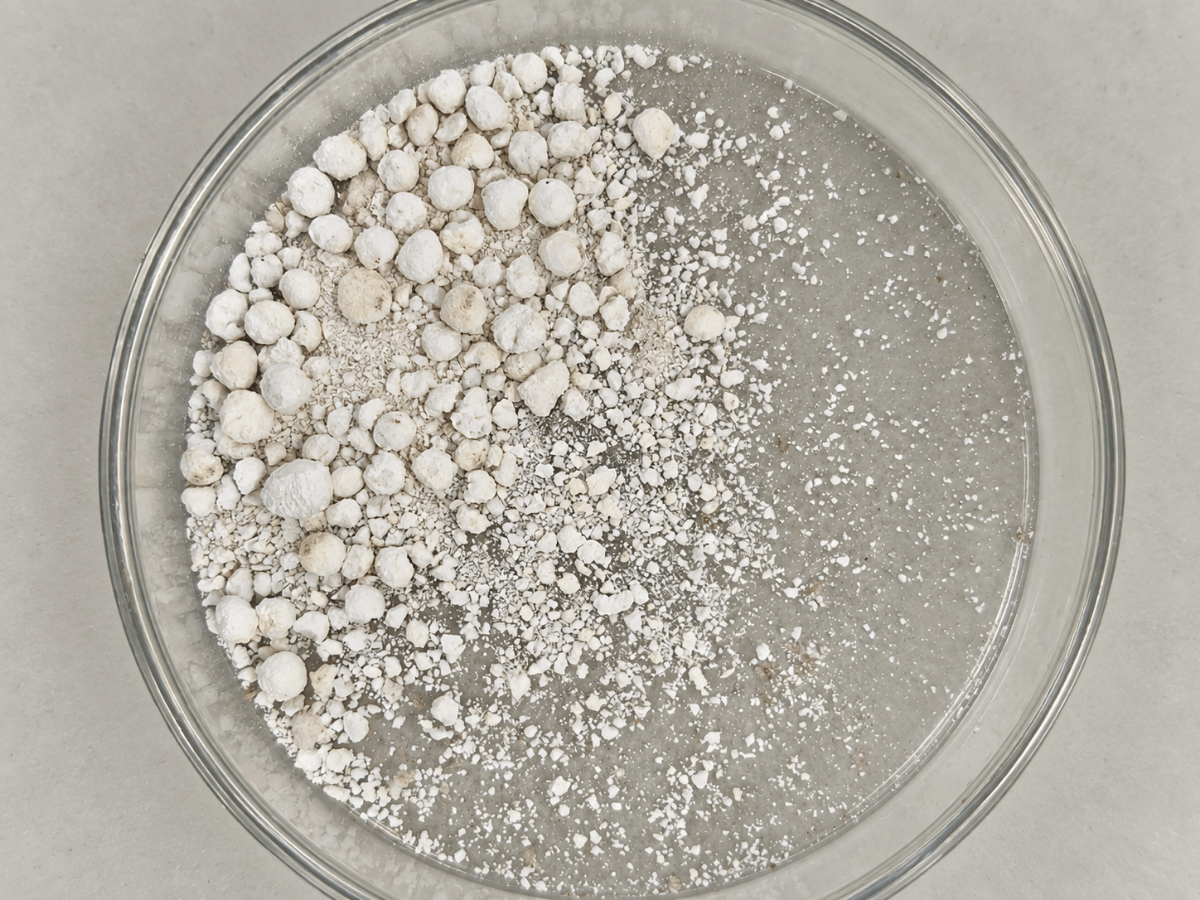
KAPSOM’s R&D team has been developing a composite ammonia adsorbent designed to combine chemical adsorption capacity with improved particle stability.
In a recent small-scale test conducted at 3 MPa and corresponding to an ammonia production scale of approximately 1 kg/day, the adsorbent achieved an ammonia uptake of approximately 0.16 g NH₃ per gram of adsorbent.
The test also examined whether the material could maintain its physical structure and repeatable adsorption performance during adsorption–desorption operation. The composite formulation was designed to limit particle swelling, agglomeration and pulverization—failure modes that can prevent high-capacity metal salts from being used in practical packed-bed systems.
These results are specific to the tested pressure, temperature, gas composition and operating procedure. The measured uptake should therefore not be interpreted as a universal working capacity under all process conditions.
Capacity Must Be Evaluated Across Cycles
For commercial operation, the first adsorption cycle is only the starting point. A practical material must maintain useful capacity over repeated adsorption and regeneration.
The most important long-term indicators include:
An adsorbent that captures a large amount of ammonia but requires high-temperature regeneration may lose its energy advantage. Similarly, a material with excellent initial uptake may be unsuitable if particles break down and restrict gas flow after repeated cycling.
From Adsorbent Material to Separation System
Adsorbent development must ultimately be evaluated at the system level. Bed size, regeneration method, heat integration, switching strategy, pressure loss and product recovery all influence whether the material can reduce the cost or energy consumption of ammonia separation.
KAPSOM is therefore studying ammonia adsorption as part of a modular separation architecture rather than as an isolated material. Adsorption, absorption and membrane separation can potentially be arranged around an ammonia synthesis loop to improve ammonia removal and reduce recycle requirements while allowing the reactor and separation units to be optimized independently.
The objective is not simply to create an adsorbent that captures more ammonia. It is to develop a material and process that can adsorb, regenerate and repeat reliably under realistic operating conditions.





Leave A Message
Scan to Wechat :

 IPv6 network supported