Leave A Message


Application of Microchannel Reactor in Fertilizer Synthesis
Conventional fertilizer supply chains are centralised and slow. Ammonia is typically produced in large plants, converted into downstream liquid fertilizers, and transported over long distances before reaching farms. During storage and transport, liquid fertilizers experience ageing effects such as pH drift, by-product formation, and solubility changes. Regulatory pressure and decarbonisation targets are now accelerating interest in distributed, low-carbon fertilizer production located closer to end users.
Modular fertilizer production units offer a pathway to shorten supply chains and reduce emissions. At the same time, intensified reaction technologies, particularly microchannel reactors, are emerging as potential enablers of real-time fertilizer synthesis. KAPSOM is exploring the integration of microchannel reactors into modular green ammonia and liquid fertilizer systems. This article summarises two laboratory-scale studies evaluating their application in fertilizer synthesis.
Case Study 1: Continuous synthesis of MAP and DAP
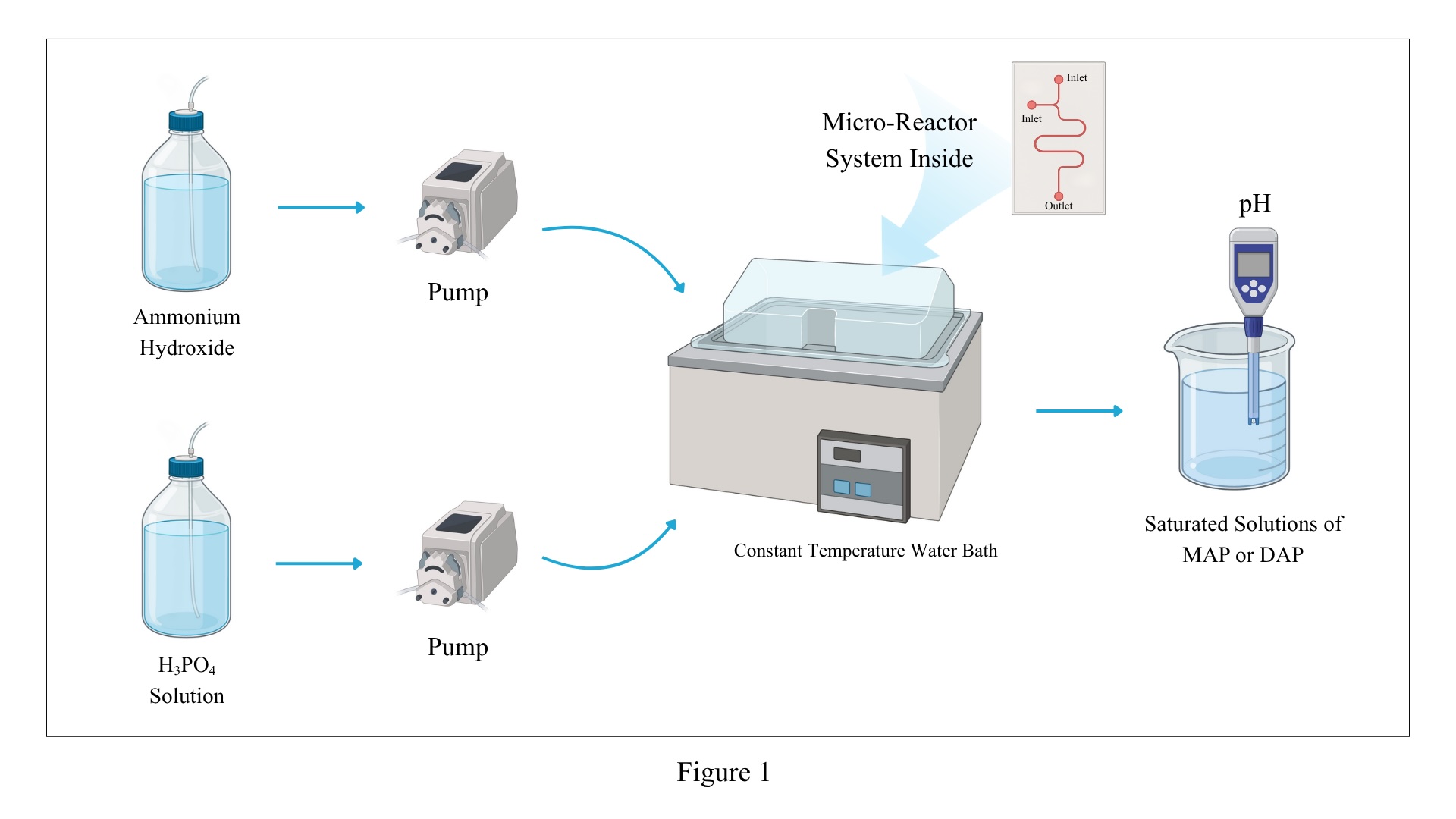
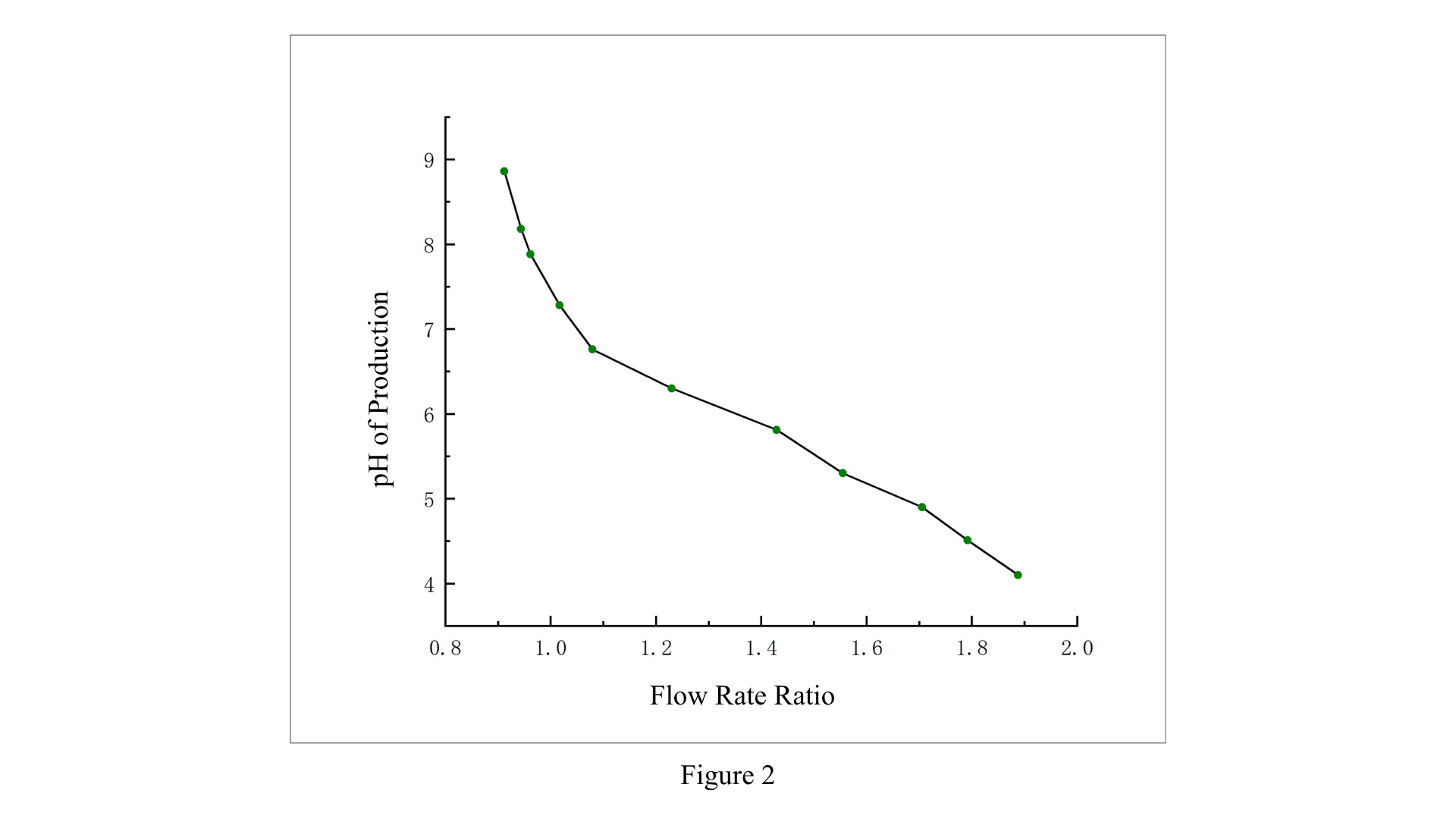
The first study investigated the continuous synthesis of monoammonium phosphate (MAP) and diammonium phosphate (DAP) solutions using a microchannel reactor. As shown in Figure 1, Aqueous ammonia and phosphoric acid were metered into a micromixer and reacted in a tubular microchannel with a 1 mm internal diameter. Product composition was controlled by adjusting the acid-to-base ratio, with real-time pH monitoring used to achieve the desired MAP or DAP formulation, as shown in Figure 2.
A major advantage of the microchannel reactor is efficient heat management. The neutralisation reaction between ammonia and phosphoric acid is highly exothermic. In conventional stirred reactors, rapid heat release can create localised hot spots, leading to ammonia slip and unstable product quality. The high surface-area-to-volume ratio of microchannels enables near-isothermal operation, ensuring uniform thermal conditions throughout the reaction. This results in homogeneous fertilizer solutions that are difficult to achieve in large batch systems.
Near-saturated MAP and DAP solutions were readily produced using this approach. However, crystallisation must be avoided inside the microchannels. Reactor temperature can be increased to enhance solubility, or operated adiabatically to partially vaporise water, allowing high-concentration solutions to exit the reactor and crystallise only during controlled downstream cooling. Compared with crystallisation from dilute solutions, this method significantly reduces energy consumption.
From an application perspective, microchannel reactors are better suited to liquid fertilizer production. Liquid MAP and DAP offer immediate nutrient availability and are compatible with precision agriculture systems such as drip irrigation and foliar spraying. Solid crystalline products remain more suitable for long-distance transport and bulk trade.
Case Study 2: Urea-Formaldehyde Synthesis
The second study focused on urea-formaldehyde (UF), a widely used controlled-release nitrogen fertilizer with strong crystallisation tendencies. UF synthesis was examined using both conventional stirred reactors and microchannel reactors.
Industrial UF production typically involves two pH-controlled steps: alkaline hydroxymethylation at 35–45°C, followed by mild-acid polycondensation at 40–80°C and pH 4.5–5.5. A one-step acid-catalysed route was initially tested in the microchannel reactor but produced excessive insoluble polymers due to uncontrolled chain growth and partial urea hydrolysis. As a result, a two-step synthesis strategy was adopted.
In the first hydroxymethylation step, conventional stirring was replaced with a microchannel reactor, while the condensation step was retained in a stirred vessel. Formaldehyde conversion exceeded 90% within 75 minutes, comparable to laboratory-scale beaker experiments. However, this similarity does not translate to industrial scale. In large stirred tanks, mixing times may exceed reaction times, leading to concentration gradients and uneven polymerisation.
Microchannel reactors overcome this limitation through micromixing. Laminar flow and extremely short diffusion distances ensure uniform reactant distribution on the millisecond scale, allowing reaction kinetics to be governed by intrinsic chemical rates rather than mixing efficiency. This results in more stable and reproducible UF synthesis.
Microchannel systems also offer energy advantages. Conventional UF reactors rely on high-speed agitation, whereas microchannel reactors scale by numbering-up. Pumping energy requirements are significantly lower than agitator power, improving overall energy efficiency.
Hybrid Operation and Safety Considerations
Further work explored hybrid microchannel–stirred reactor configurations, in which the microchannel performs a controlled pre-reaction prior to crystallisation, followed by completion in a stirred reactor. Precise residence time control is essential to prevent channel blockage. Millimetre-scale channels, vacuum-assisted flow, and dynamic tubular reactor concepts were evaluated to mitigate fouling risks.
Microchannel technology is well suited to distributed fertilizer production from a safety perspective. Reactor hold-up volumes are typically only a few litres, providing intrinsic safety compared with conventional reactors containing large inventories of hot or reactive chemicals. This reduces regulatory and insurance barriers for deployment in agricultural regions.
Conclusion
These laboratory-scale studies demonstrate the potential of microchannel reactors for modular and distributed fertilizer synthesis. Advantages include enhanced heat and mass transfer, precise reaction control, lower energy consumption, and improved safety. While crystallisation-prone systems remain challenging, hybrid reactor concepts offer viable solutions. Microchannel technology represents a promising pathway toward flexible, low-carbon fertilizer production aligned with future agricultural and environmental demands.





Leave A Message
Scan to Wechat :

 IPv6 network supported