Leave A Message


Why Catalyst Activity Is Not Enough
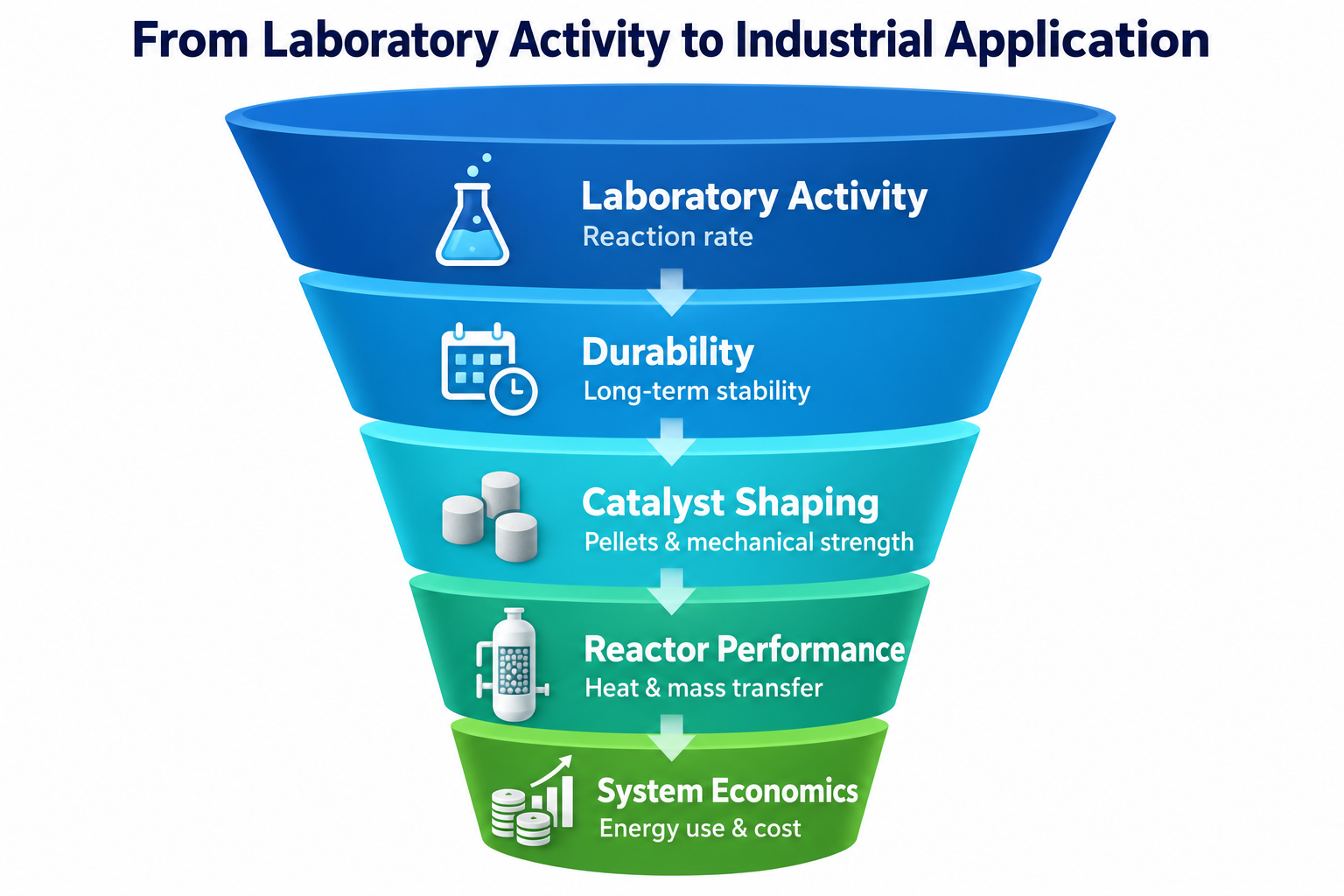
The previous article examined how a more active catalyst could expand the operating window for lower-pressure ammonia synthesis. But activity measured in a laboratory is only the first requirement. A catalyst must also remain stable, manufacturable and economically viable inside a complete synthesis loop.
This distinction matters because many promising materials perform well under carefully controlled conditions but face additional challenges when exposed to industrial gas feeds, repeated start-ups and shutdowns, or thousands of hours of continuous operation.
Beyond the Activity Number
Catalyst performance is often presented as an ammonia formation rate measured at a specific temperature, pressure and gas flow rate. This is useful for comparing materials, but it does not fully describe industrial performance.
A commercially practical catalyst must also provide:
The catalyst must also work at a practical size and shape. A powder with high laboratory activity may create excessive pressure drop or poor gas distribution when placed in a large reactor. Turning it into pellets can change its surface area, pore structure and apparent activity.
Promising Materials, Different Challenges
Several emerging catalyst families could contribute to lower-temperature or lower-pressure ammonia synthesis.
Electride-supported catalysts, including materials based on C12A7 electrides, can donate electrons to active metals and promote nitrogen activation. When combined with ruthenium, they may also help reduce hydrogen poisoning. However, support stability, preparation complexity and scale-up cost remain important questions.
Lithium hydride–transition metal systems may activate nitrogen through reaction pathways that differ from conventional surface dissociation. This could reduce the kinetic barrier associated with breaking the nitrogen–nitrogen bond. Their sensitivity to air, moisture and operating conditions must nevertheless be addressed before industrial deployment.
Transition-metal nitrides can use nitrogen vacancies or lattice nitrogen during the reaction. They offer an alternative to conventional iron and ruthenium systems, but their long-term structural stability and regeneration behaviour require further validation.
These materials should therefore be viewed as promising development platforms—not automatic replacements for promoted iron catalysts.
Reactor Results Are Not Plant Results
Even a substantial improvement in catalyst activity does not translate directly into the same percentage reduction in plant energy consumption or ammonia production cost.
In a conventional synthesis loop, single-pass ammonia conversion is often only around 20%. Through ammonia condensation and recycling of unreacted nitrogen and hydrogen, overall fresh-feed conversion can exceed 99%.
This illustrates why plant performance depends on more than the reactor. If operating pressure is reduced, ammonia becomes more difficult to condense. The system may then require higher recycle flow, stronger separation technology or additional compression. Part of the energy saved in the reactor section could be transferred to another part of the process.
The correct question is therefore not simply, “Which catalyst produces the most ammonia?” It is, “Which catalyst produces ammonia most effectively within the intended reactor and separation system?”
Flexible Operation Adds Another Test
Renewable ammonia plants may need to respond to changing hydrogen and electricity availability. Their catalysts could experience temperature fluctuations, pressure changes and repeated operating cycles more frequently than conventional large-scale plants.
Testing should therefore include start-stop cycles, partial-load operation and recovery after process disturbances—not only steady-state activity. A catalyst that achieves a slightly lower peak formation rate but maintains its performance after repeated cycling may be more valuable than one that delivers an exceptional initial result and deactivates rapidly.
From New Materials to Better Ammonia Plants
Next-generation ammonia synthesis will not be enabled by one record-breaking material alone. Progress requires coordinated development of catalyst formulation, catalyst shaping, reactor design, product separation and recycle control.
For KAPSOM, catalyst research is therefore evaluated as part of a complete process-development programme. The objective is not only higher laboratory activity, but a catalyst that can support lower-pressure, flexible and commercially practical ammonia production.
The most successful catalyst will not necessarily be the one with the highest number in a laboratory test. It will be the one that improves the performance of the entire plant.





Leave A Message
Scan to Wechat :

 IPv6 network supported