Leave A Message


Can Better Catalysts Lower Ammonia Synthesis Pressure?
In earlier articles, we explored how membranes and adsorbents can remove ammonia from the reaction system. These technologies improve the separation side of the process. But what can be changed on the reaction side?
One possible route is to develop catalysts that remain highly active under milder conditions. A better catalyst can reduce the pressure required to achieve an economically useful reaction rate—but catalyst activity alone does not determine the optimum operating pressure.
What Can a Better Catalyst Change?
Ammonia synthesis begins with one of the strongest bonds in chemistry: the nitrogen–nitrogen triple bond has a dissociation energy of approximately 941 kJ/mol. Breaking and activating this bond is one of the main kinetic barriers in the Haber–Bosch process.
A catalyst provides an alternative reaction pathway with a lower activation barrier. A more active catalyst may therefore:
However, a catalyst does not change the thermodynamic equilibrium of the reaction. It may help the system approach equilibrium faster, but it cannot increase the equilibrium ammonia concentration at a given temperature and pressure.
Why Promoted Iron Still Matters
Promoted iron remains the standard catalyst for industrial ammonia synthesis because it combines acceptable activity with durability, availability, and manageable cost.
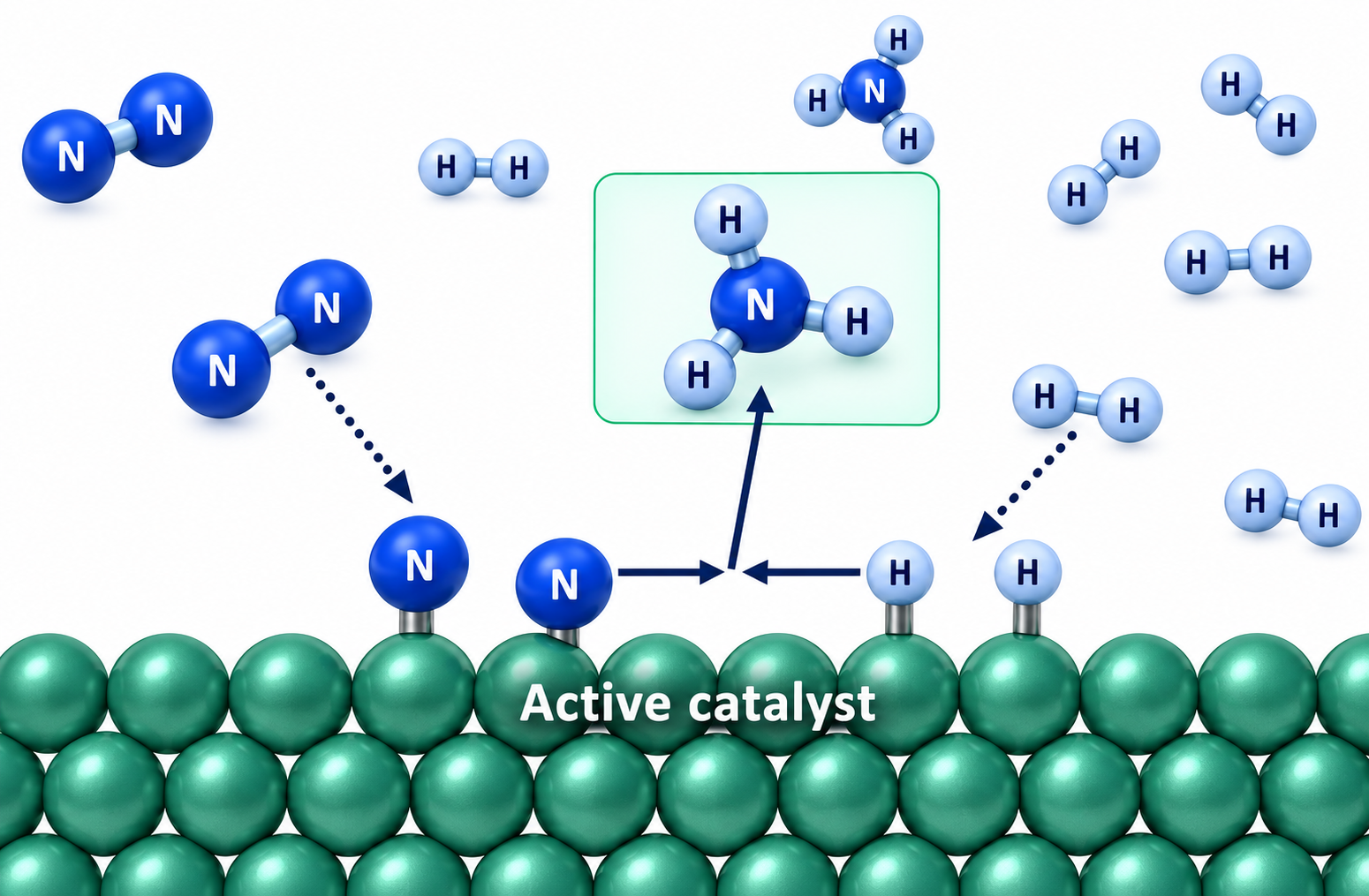
Its performance depends heavily on promoters. Potassium-containing compounds can improve the electronic properties of the active surface, while aluminium and calcium compounds help maintain catalyst structure and stability. The objective is to balance nitrogen adsorption: nitrogen must bind strongly enough to be activated, but not so strongly that reaction intermediates block the surface.
Ruthenium-based catalysts can offer higher intrinsic activity and may operate under milder conditions. However, ruthenium is scarce and expensive, and its performance can be affected by hydrogen poisoning. For many commercial projects, the question is therefore not simply whether ruthenium is more active, but whether its additional activity justifies its cost and operating requirements.
Hybrid or staged iron–ruthenium configurations may eventually offer a compromise, but promoted iron still provides a practical platform for near-term improvement.
KAPSOM’s Catalyst Development
KAPSOM has developed an internally formulated rare-earth-promoted iron catalyst. In internal evaluations under matched test conditions, it demonstrated 60–90% higher catalytic performance than commercial promoted iron catalysts.
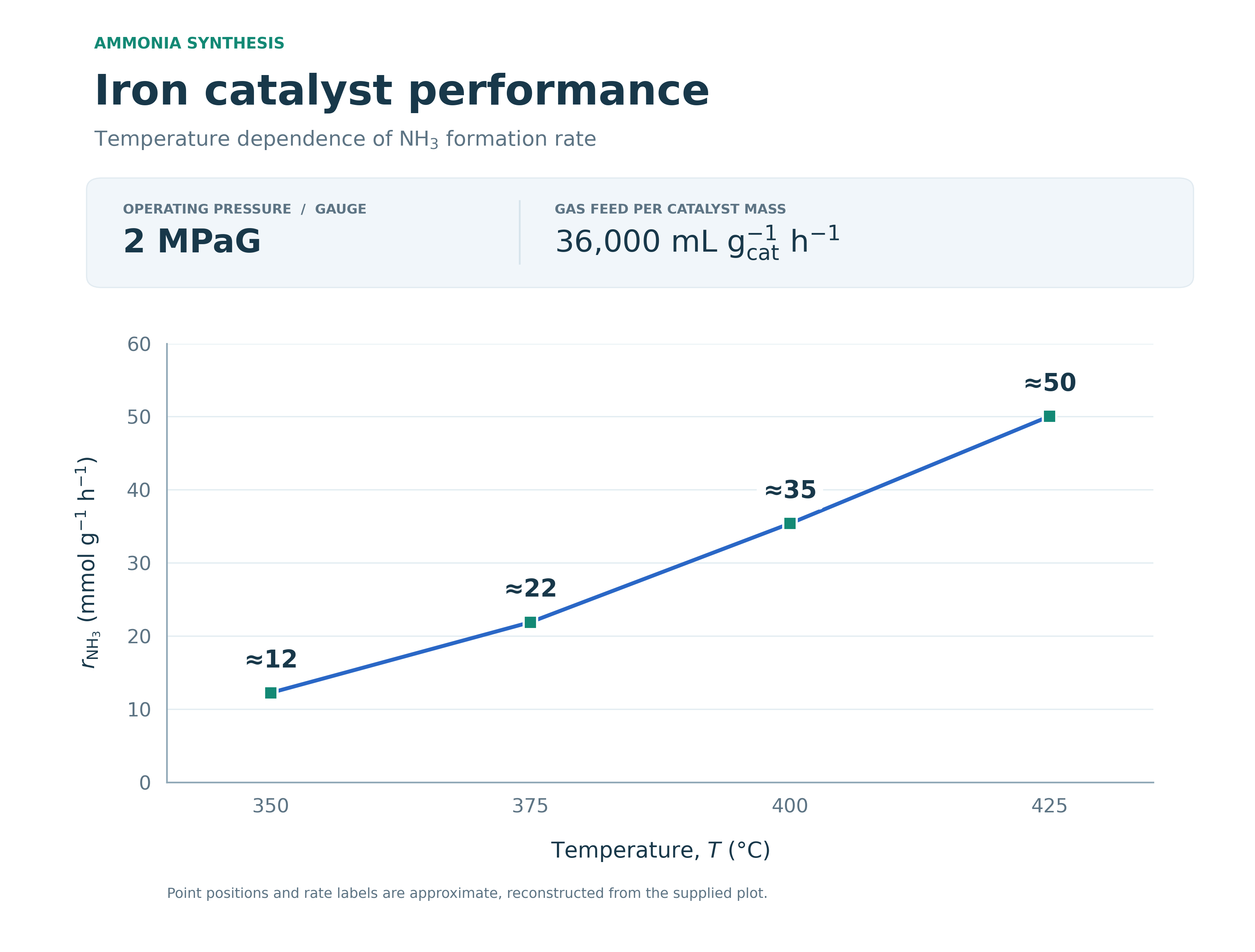
Separate temperature-response testing was conducted at 2 MPa(g) and a normalized gas flow rate of 36,000 mL/(gcat·h). The measured ammonia formation rate increased from approximately:
These results show that the catalyst remains responsive across a broad temperature range. They should not, however, be interpreted as direct proof of the optimum pressure for a complete industrial synthesis loop.
Process simulations conducted by KAPSOM indicate that approximately 7 MPa may be a promising operating pressure for a lower-pressure ammonia synthesis system. This is not a universal design value: the optimum depends on catalyst activity, reactor conditions, recycle composition and ammonia separation performance.
For context, KAPSOM’s current modular systems can operate from 20% to 110% of rated load, with ramp rates above 2% per minute, at approximately 9 MPa and 450°C. A more active catalyst could help extend this flexible platform toward lower-pressure operation.
Why Pressure Cannot Keep Falling
Higher pressure serves two purposes: it favors ammonia formation and makes ammonia easier to condense. As pressure falls, equilibrium conversion decreases and cooling-based ammonia recovery becomes less effective. More ammonia may remain in the recycle gas, increasing circulation and separation duties.
Operating below 5 MPa may become technically possible, but only if improved catalysis is combined with more effective product removal. As discussed in the previous articles, membranes and adsorbents could contribute to this task.
From Catalyst Improvement to System Improvement
The real opportunity is not a catalyst operating in isolation. It is a synthesis loop in which the catalyst, reactor, separation unit and recycle system are designed together.
A better catalyst can open the door to lower-pressure ammonia synthesis. Whether the process can pass through that door depends on how effectively the rest of the system supports it.





Leave A Message
Scan to Wechat :

 IPv6 network supported