Leave A Message


Do Membrane Reactors Fit Ammonia Cracking?
Membrane reactors can improve ammonia conversion and separate hydrogen within the same unit. However, greater process integration does not automatically produce a better commercial system.
For modular ammonia cracking, the real question is not whether a membrane reactor works. It is whether the additional conversion and process intensification justify the higher material cost, sealing requirements and operational interdependence. In many applications, a conventional cracking reactor followed by a separate membrane unit may offer a more practical balance between performance, reliability and maintainability.
How a Membrane Reactor Changes Ammonia Cracking
Ammonia decomposes into hydrogen and nitrogen: 2NH₃ → N₂ + 3H₂
In a conventional reactor, hydrogen remains in the reaction gas until it reaches a downstream purification unit. A hydrogen-selective membrane reactor removes part of the hydrogen directly from the reaction zone.
According to Le Chatelier’s principle, lowering the hydrogen partial pressure shifts the equilibrium toward further ammonia decomposition. This creates three potential benefits:
This approach is particularly attractive where equilibrium limits conversion or where reaction and purification can be combined without compromising equipment reliability.
What Experimental Studies Have Achieved
Published studies have demonstrated the technical potential of ammonia cracking membrane reactors. One pressurized system using a palladium-based hydrogen-selective membrane produced hydrogen with a purity above 99.97% and achieved a hydrogen recovery rate above 90%. Another study using a palladium-composite membrane reported approximately 99.6% ammonia conversion at 745 K, or about 472 °C, and 500 kPa gauge pressure. The resulting hydrogen purity reached 99.99%, with a hydrogen recovery rate of approximately 87%.
These results demonstrate the main attraction of a membrane reactor: ammonia conversion and hydrogen purification can be improved simultaneously. However, the figures were obtained with specific catalysts, membrane materials, pressures, flow rates and reactor configurations. They should not be interpreted as guaranteed performance for every ammonia cracking system.
Is the Additional Conversion Worth the Complexity?
For ammonia cracking, the value of equilibrium enhancement may become less significant as temperature increases. Higher temperatures increasingly favor ammonia decomposition, allowing a well-designed conventional reactor to achieve high conversion without removing hydrogen inside the reaction zone.
In one KAPSOM internal study, adding membrane separation within the reactor increased ammonia conversion from approximately 90% to 96% under the investigated conditions. A six-percentage-point improvement is technically meaningful, but it must be evaluated against the additional cost and engineering risk of an integrated membrane reactor. Higher conversion alone does not demonstrate that the complete system is more economical or more reliable.
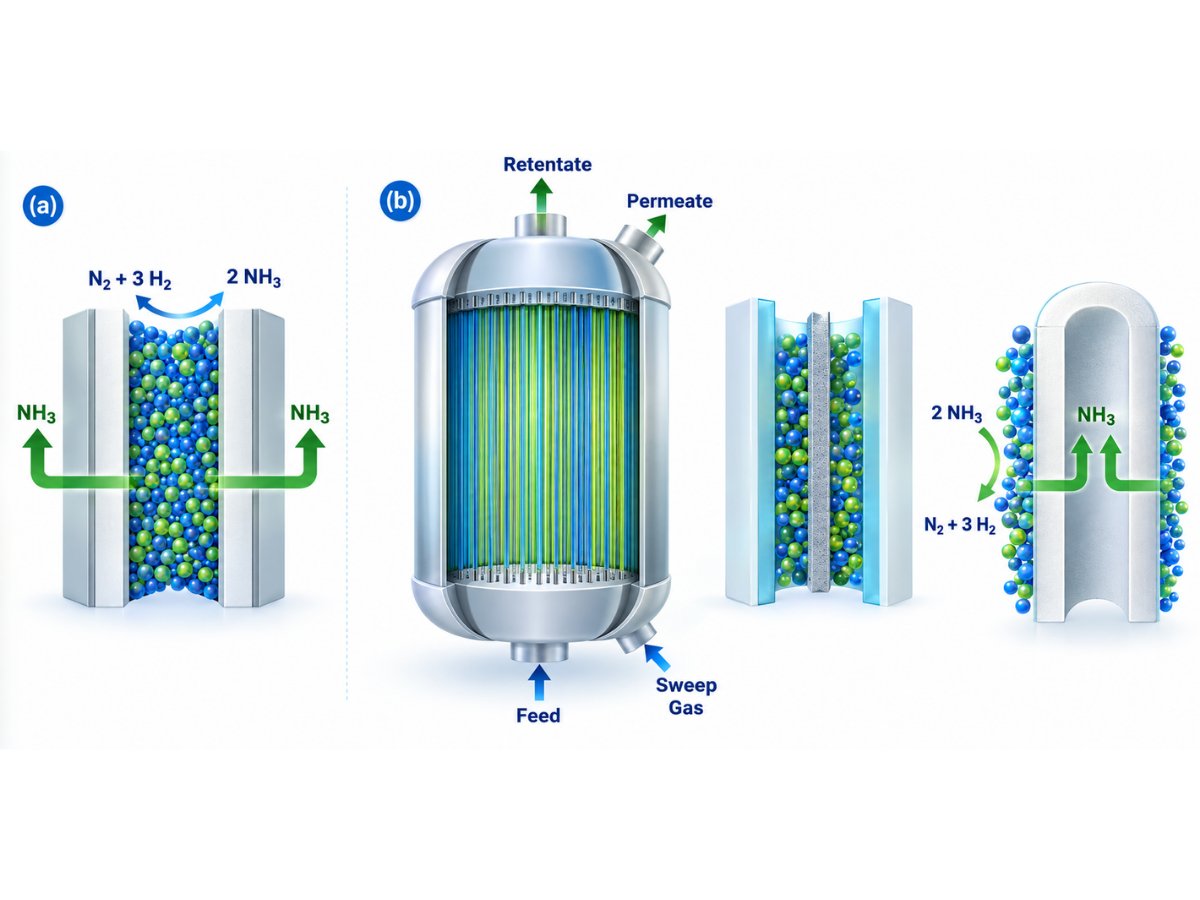 Schematic Diagram of a Membrane Reactor for Ammonia Synthesis
What Engineering Risks Does Integration Introduce?
A membrane reactor combines several functions inside one highly interdependent unit:
The catalyst and membrane may also have different preferred operating conditions. A higher temperature can improve cracking kinetics but accelerate membrane degradation, thermal expansion or sealing failure. Membrane fouling or loss of selectivity may affect reactor conversion, while catalyst degradation can change the gas composition reaching the membrane.
Maintenance is another concern. In an integrated reactor, replacing the catalyst, membrane or sealing components may require opening or shutting down the same pressure-containing unit. A failure in one function can therefore interrupt the entire reaction and separation process.
These risks are especially important for distributed hydrogen systems, where simple operation and limited maintenance requirements may be more valuable than maximizing conversion within a single piece of equipment.
Why Separate Reaction and Separation?
A conventional reactor followed by a separate membrane module retains many of the advantages of membrane separation without placing the membrane directly inside the reaction zone.
In this configuration, the cracking reactor can be optimized for catalyst activity, temperature and ammonia conversion. The downstream membrane unit can be optimized independently for hydrogen purity, recovery, pressure ratio and membrane lifetime.
The two modules can also be maintained, replaced or upgraded separately. This reduces development risk, simplifies scale-up and makes it easier to adapt the system to different feed conditions or hydrogen specifications.
KAPSOM has applied this principle in a modular ammonia-to-hydrogen system using downstream metal membrane separation. In a project study at 100 Nm³/h hydrogen capacity, the system demonstrated the ability to produce hydrogen with a purity above 99.999% for fuel-cell power generation.
The purpose of this configuration is not to reject membrane technology. It is to place the membrane where its separation advantages can be used without unnecessarily coupling its operation to the cracking catalyst.
When Can a Membrane Reactor Make Sense?
An integrated membrane reactor may be attractive when:
For many commercial modular systems, however, the most highly integrated design may not be the most practical one. A separate reactor and membrane unit can still provide high ammonia conversion and ultra-high-purity hydrogen while offering greater flexibility, maintainability and operational reliability.
The best system should therefore be selected on total lifecycle performance—not conversion alone.





Leave A Message
Scan to Wechat :

 IPv6 network supported